
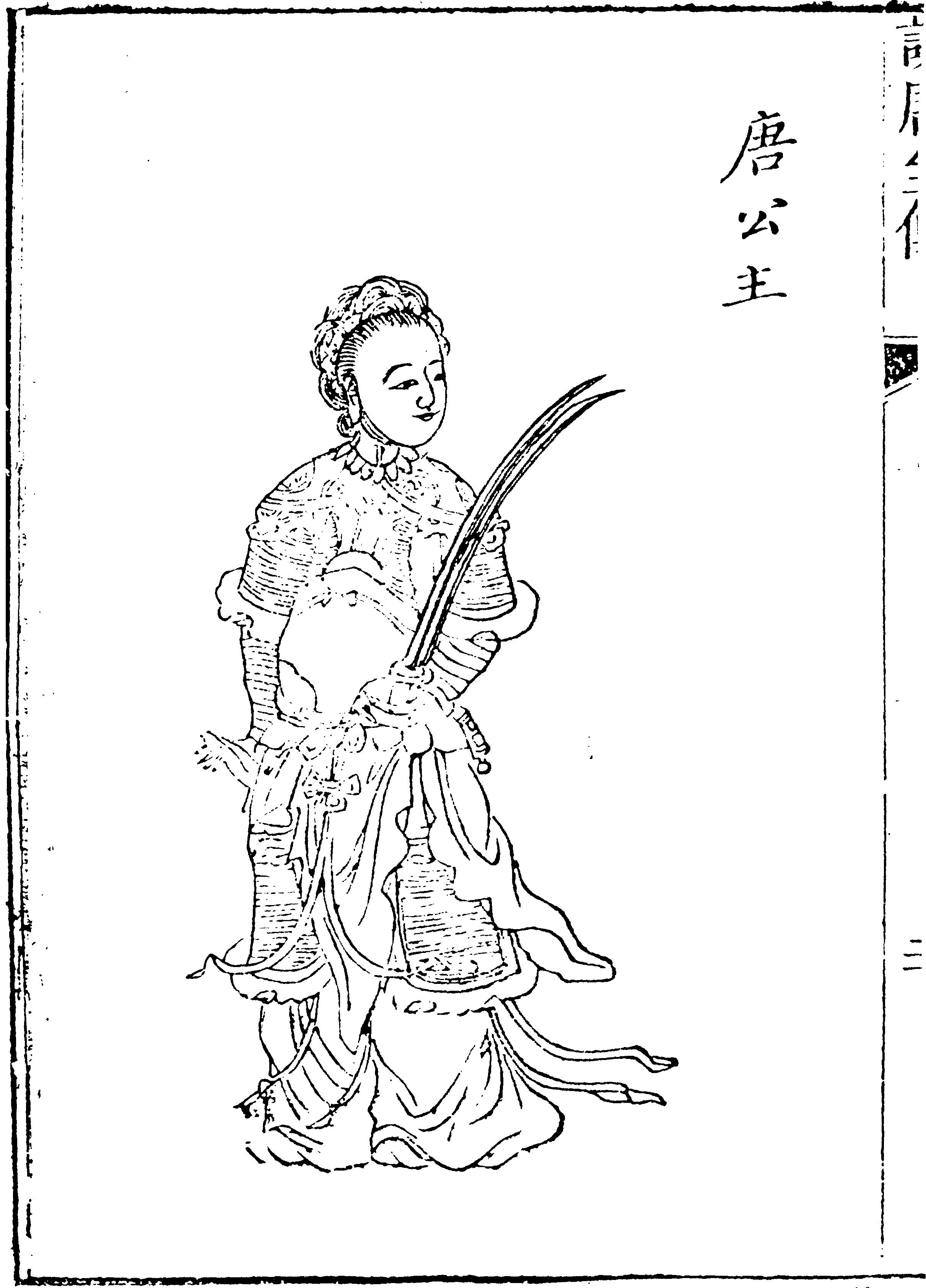
After the untimely death of his daughter Princess Pingyang, Gaozu, the founding emperor of the Tang dynasty, decreed that her funeral procession be accompanied by “fife and drum.”
This caused consternation at the Bureau of Rites, where officials declared that according to their reading of the rules, only men were eligible to receive the military honors of fife and drum. Gaozu disagreed, issuing an edict that stressed how vital the princess had been to the success of his rebellion:
Fife and drum is the music of the army. Previously, the Princess raised troops at Sizhu to join the righteous campaign; [by then,] she controlled the signal gongs and drums [that is, she herself gave orders of retreat and attack to the army]. She has the merit of pacifying the realm. The Princess has contributed to the founding of the imperial enterprise. She was not simply one of the ordinary women! How can her [burial ceremony] be without fife and drum?
(From Shoufu Yin’s Rewarding Female Commanders in Medieval China, Official Documents, Rhetorical Strategies and Gender Order.)
No ordinary woman! According to the Old Book of Tang, when Gaozu raised his standard against the tyrannical Sui Wendi in 617 A.D., Pingyang “used the family property to recruit men at large in the mountains,” and then personally led her “Army of the Lady” (娘子軍) to assist her father and brothers in the conquering of the Sui dynasty capital city of Changan.
That’s pretty much all the chronicles have to say about the Princess. As a general rule, the compilers of the Tang dynastic histories were not eager to praise the role that women played in imperial power politics. They reserved particular vehemence for their depiction of Empress Wu Zetian, who took power under her own name a little more than 150 years after Princess Pingyang died, decrying her as a blood-thirsty degenerate who transgressed the social order.
The reluctance of the historians to praise assertive women stemmed from the same general source as the prickliness of the officials of the Bureau of Rites. Drawn from the literati class, they shared common values and racial backgrounds: they were, for the most part, ethnically Han men steeped in Confucian tradition who viewed any violation of the rigid hierarchical relationships that organized Confucian society with great suspicion.
But the men and women of the Tang dynasty imperial family? They were something quite different.
“The Tang dynasty originated from the Barbarians. It is for this reason that violations of the Confucian standard governing a woman’s proper behavior were not regarded as anything unusual.”
[Song Dynasty Neo-Confucian philosopher] Zhu Xi (as translated by Chen Sanping in Multicultural China in the Early Middle Ages.)
The Tang imperial family went to great lengths to trace their lineage back to ethnically Han roots, but Zhu Xi’s scornful comments, set down some 500 years after the founding of the Tang dynasty, makes clear that their real identity was no secret. The Tang emperors had plenty of non-Han steppe nomad blood running through their veins.
In the interregnum between the fall of the Han dynasty in 220 A.D. and the rise of the Sui dynasty in 581, an assortment of tribal nomads that have been loosely grouped under the names “Xianbei” or “Serbi” poured into the Chinese central plains. One sub-grouping, the Tuoba Xianbei, established a succession of regimes known to history as the “Northern Dynasties.” These included the Northern Wei, the Eastern and Western Wei and the Northern Qi and the Northern Zhou.
The Sui dynasty that reunified “China” for the first time since the Han dynasty overthrew the Northern Zhou and were themselves in turn overthrown by the Tang, who then initiated one of the most glorious efflorescences of Chinese culture to date. But it is a mistake to draw a sharp distinction between Sui/Tang and the Northern dynasties. The ancestors of both the Sui and Tang ruling families had been living under Tuoba rule for centuries. Many of them served as generals in Tuoba armies and they were tightly linked, by both marriage and culture, to the Tuoba Xianbei aristocracy. Princess Pingyang’s mother and grandmother were both Tuoba. Her brother, Taizong, married a woman from the imperial family of the Northern Zhou.
The historian Chen Sanping goes as far as to argue that, in the comfort of their own private quarters, for at least the first century of the dynasty, the ruling family most likely spoke a Tuoba Xianbei dialect closely related to Turkish. For the entire first half of the dynasty, high ranking men at court commonly wore a form of “riding dress” with obvious links to steppe nomad horse culture.
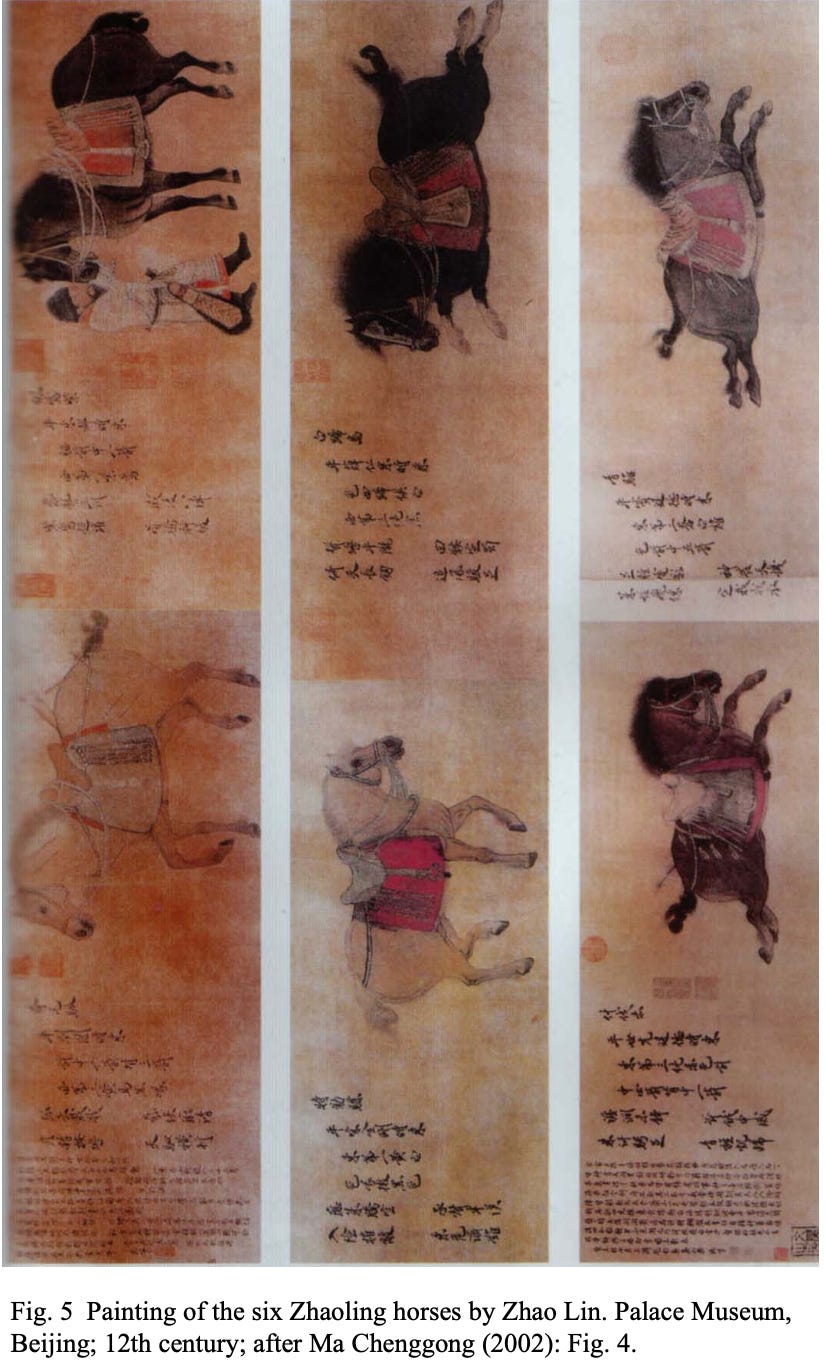
Taizong, the second emperor of the dynasty, who killed his older brother, the crown prince, and his younger brother, and forced his father into early retirement, (bloodthirsty degeneracy was kind of a family trait) was notoriously infatuated with his horses, so much so that he ordered that his magnificent tomb include carved likenesses of his six favorite steeds, along with poems honoring their individual memory.
Of the horse Saluzi, 颯露紫, who is depicted with an arrow being pulled from his side, it was written:
It was as restless as a purple swallow,
It pranced with its high spirits;
It was feared along the region of the three rivers,
It struck awe into the enemy on all battlefields.
Taizong’s unfortunate son and one-time heir Chengqian was much mocked in the Tang dynasty histories for his love of Turkish music and dance, which the historians cited as obvious proof of his eccentricity and unworthiness to rule China. But as Chen Sanping points out, in proper historical context this was perfectly normal behavior for a descendent of steppe nomads! Or as Marc Abraham put its “it is probable, however, that Chengqian’s behavior, far from being neurotic or exceptional, reflected one end of normative behavior in the imperial family that was strongly acculturated away from Chinese norms in many respects.”
The “mestizo” identity of the Tang family was so obvious at the time that for the first 200 years of the dynasty, the most elite and ancient “Han” families refused to allow their sons and daughters to marry into the imperial family!
But for my purposes here, the most interesting “respect” in which the Tang dynasty ruling family deviated from Chinese norms has to do with the role of women. The Tuoba Xianbei accorded far more autonomy to women than did traditional Confucian culture. This could potentially explain why, as noted previously in this series, in imperial China, “women never had it as good” as they did during the Tang. Understanding Tuoba tradition also makes the ascension of Empress Wu to the throne much less of a transgressive outlier.
In her terrific The Women Who Ruled China: Buddhism, Multiculturalism, and Governance in the Sixth Century, published in 2024, Stephanie Balkwill takes a close look at the Northern Wei dynasty, the first of the great Tuoba Xianbei regimes. Her particular focus is the Dowager Empress Ling, who exercised power in the early sixth century. But Ling was hardly the only woman of note who prospered during the Northern Wei. Balkwill observes that several abbesses of Buddhist nunneries had significant influence at court and role-modeled examples of how women could wield authority. Balkwill theorizes that this phenomenon traces back to cultural values particular to Xianbei/Serbi society.
The independence that she [Empress Dowager Ling] displayed throughout her life may have been owing to the fact that even though she was said to be of Han descent, she was born into the culturally hybrid context of the northwest border regions at the gateway to the Hexi corridor. Such a cultural background may have allowed her to fulfill different types of gender roles than those advocated by Han scholars like Cui Guang — may have allowed her to shoot, as it were. Archeological evidence suggests that Serbi [Xianbei] women could shoot: A recently unearthed Serbi [Xianbei] tomb from Mongolia has revealed the skeletons of two women whose skeletal remains show repetitive stress injuries related to archery and spinal trauma associated with extensive horse-back riding, a fact that has led bioarcheologist Christine Lee to argue for the existence of gender equality in Serbi [Xianbei] society.
Which brings us, finally, to Mulan.
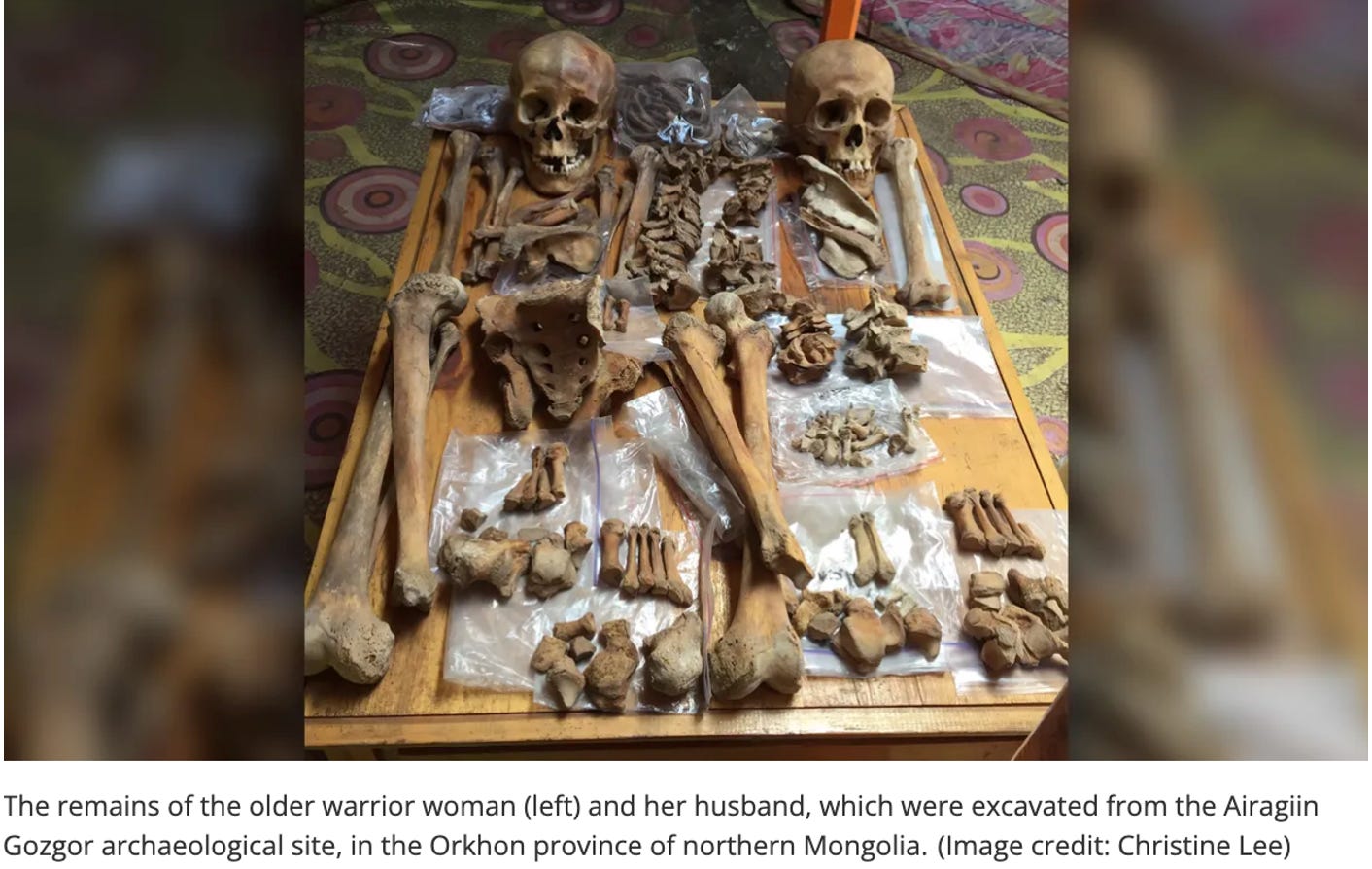
This study looked for evidence of women warriors among the nomadic pastoralists of ancient Mongolia. Twenty-nine elite burials (16 males, 10 females, 3 indeterminate) were analyzed. These were divided into three time periods, Xiongnu (209 BC-93 AD), Xianbei (147-552 AD), and Turkic (552-840 AD). Potential warriors were defined through evidence of prolonged horseback riding, archery, and trauma patterns…. Xianbei Period women appear to be the most martial and mobile… So, the Xianbei Period has the best evidence for potential warrior women. This time period is associated with the Ballad of Mulan and was characterized by political fragmentation and unrest. It may have been that women were needed to defend home and country alongside the men.
Where are the women warriors? Evidence for Gender Equality on the Mongolian Steppe (209 BC-840 AD). American Association of Physical Anthropology, Los Angeles, 2020. Christine Lee and Yahaira Gonzalez
Countless movies, books, poems, plays and TV shows have depicted the legendary woman warrior Hua Mulan as a paradigmatic example of Confucian feminine filial piety. With her father too frail to fight for the emperor against invading barbarians, Mulan volunteers to take his place, dresses as man, and has a spectacular ten-year career as a warrior. But after finishing defending the realm she retires from the army, puts her women’s clothes back on, and lives out her life as a woman devoted to her family in the best traditional Confucian sense.
Plot twist: The first historical evidence we have of the legend of Mulan is a poem titled “The Ballad of Mulan” whose authorship has been traced back to the Northern Wei dynasty. This has led some scholars to postulate that, real or fictional, the original Mulan wasn’t even Chinese; most likely, she was a Tuoba warrior woman, fighting for the Tuoba emperor against his own enemies! She was a barbarian!
…the image of Mulan, as a Chinese scholar has noted, is “unprecedented in the classical poetry of our country.” Her major characteristics – valor, fighting skills, and resourcefulness in military affairs – align her with the images of Northern horsewomen in other poems of the same period… these poetic images of horsewomen reflect the cultural values shared by all the ethnic groups, and the Xianbei in particular, that were then living in war-torn Northern-China… such a literary character could come into being only in a specific social locale and at a specific historical moment when the official Chinese ideology – namely Confucianism – had lost its sway and, in its stead, new values were being formed as a result of tremendous social changes and ethnic interactions. In other words, the genesis of the Mulan poem was actually due to the absence of Confucian influence rather than to a desire to celebrate Confucian values.
Feng Lan, The Female Individualist
Cosmopolitanism, defined as “openness to foreigners and their diverse ways of life” according to Lewis, is a word commonly used to describe an essential nature of Tang society in its first half. The enthusiasm for foreigners was prominent, particularly in the cities. Many foreigners, including Turks, Uyghurs, Sogdians, and other Central Asian groups, set up residence or temporarily stayed in the empire as envoys, merchants, performers, soldiers, students and pilgrims etc. Intermarriages with foreigners were usual for Chinese of both high and low social status. Reflecting the diverse cultural backgrounds of residents, the capital city of Changan had institutions of various religions, such as Buddhism, Zoroastrianism, Nestorian Christianity, Daoism, and Manichaeism. People, especially aristocrats and wealthy people, all followed fashions in foreign art, music, and clothing. Such cosmopolitanism has been generally attributed to Tang’s military, economic and political prosperity and the open-minded attitude of the ruling elite.
Dressing as Horsemen: The universalisation of steppe dress in the first half of Tang dynasty China (618-755). Kyoko Nomoto.
“The Tang dynasty, at least during its prime, witnessed unprecedented cultural openness and tolerance.”
Chen Sanping, Multicultural China in the Early Middle Ages
The more one learns about the glory days of the Tang, the more one must ponder a central contradiction. The Tang was a fundamentally hybrid regime, a cross-fertilized melting pot of steppe nomad and Han Chinese values. The openness to foreign influence so remarked upon by observers ever since has to be at least partially explained by the mestizo identity of the ruling class.
And yet the first 150 years of the Tang dynasty is also considered the peak of traditional “Chinese” culture.
So what does it mean that the Chinese cultural glory was a product of ethnic commingling and tolerance and openness?
When I started this newsletter, during the first Trump administration, I made the explicit case that I would be writing about hybridity as part of a strategy that aimed to push back against contemporary political trends:
As a citizen of the United States at time when my government is doing everything it can to demonize immigration and reject hybridity in all its forms… it has occurred to me that telling stories about how promiscuous border-crossing and cross-fertilizing experimentation are a source of incredibly great culinary pleasure and cultural strength is more than just a quixotic obsession. I have come to see it as a mission, as absolutely mandatory. I am convinced we need more connection, more translation, more ingredients swirling in the hotpot, and more feasting together around a common table, with the wine and conversation and poetry flowing.
But I could not have predicted back then how bad things would really get. The second Trump administration is so out of tune from where I had grown up thinking my country was headed that I often find myself staring at headlines in disbelief. How can things simultaneously be so stupid and so evil? In the last few months we have witnessed the systematic purging of women and minorities from positions of power in the administration and military. We have watched the daily abduction of brown-skinned citizens off the streets by masked gunmen. Most recently, we were forced to undergo the repulsive elevation of Charlie Kirk, a man who preached bigotry with both ignorance and arrogance, into a martyr and saint. Words like “tolerance” and “empathy” have been explicitly declared anathema. Racial purity is now government policy. Queerness, of any kind, is under siege.
This is all such a misreading of history; such a misunderstanding of what could make America truly great; such a scared and ignominious retreat from the future. I have tried to escape this madness by averting my eyes and burrowing into fantasy and ancient history; I have striven to hide myself in the glories of Tang and get lost in endless wuxia narratives of flying-sword female knight-errants. But every thread I follow leads back to the same starting point: true strength and glory require the kind of bravery that embraces complication and interconnection.
Only weak and fragile men are afraid of what is different. The rest of us will let an army of steppe nomad warrior women show us the way forward.
End of Part III. Read Part IV.
Brilliant article. Taizong was also known as Tengri Khan - Heavenly Khan - so certainly the Xuanbei culture was part of who the early Tang royals were. I've seen photos of portraiture - but can't remember where - of Taizong dressed in Xuanbei clothes as the Khan. Obviously he was able to function in two cultures. Princess Pingyang sounds fascinating - would love to know more about her. Love how you relate this to current times. Great work!
Loved your article! And agree with you about the current state of policy towards immigration. It's shame inducing.